
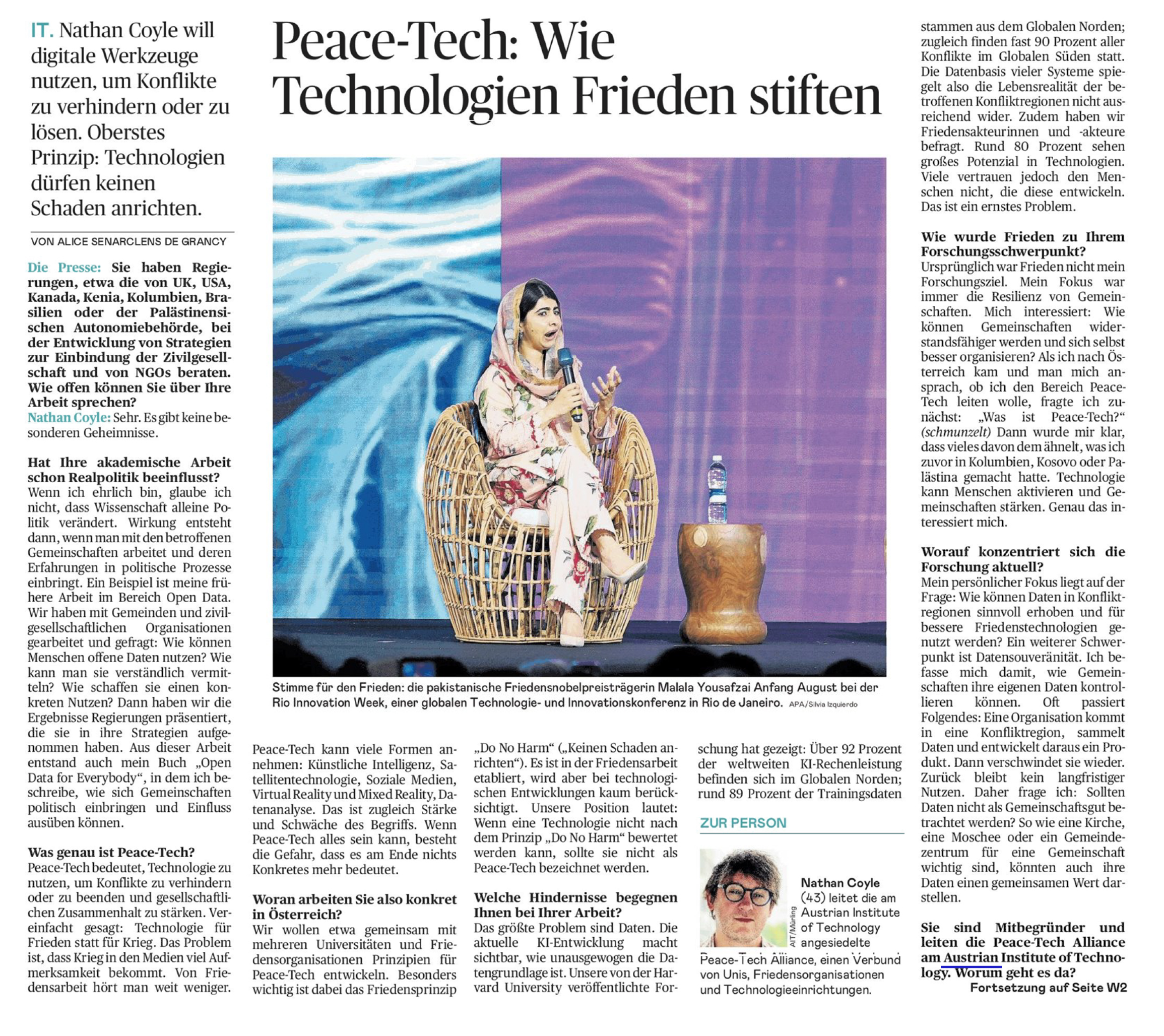
The PeaceTech Alliance's interview with Die Presse, published 27 August 2026.
BY Michael Mürling / ON 27 AUGUST, 2026
Principal of the PeaceTech Alliance, Nathan Coyle, gave the interview, published 27 August 2026 (interview by Alice Senarclens de Grancy), but the ground it covers is central to the Alliance's work as a whole.
Why Austria, and what that should actually mean. The interview leans into Austria's diplomatic tradition and Vienna's role as a meeting place for dialogue — reasons Austria could help carry PeaceTech's message further internationally, provided that voice stays grounded in the communities the field is meant to serve, not just the institutions convening around it.
We'd push that a step further. Austria has the ingredients to help here, but that role shouldn't be measured by how many PeaceTech projects get launched — it should be measured by whether the people affected by conflict have a real say in what gets built for them. Our own survey of 211 peacebuilding practitioners found something worth taking seriously: most see real potential in technology, but many don't yet trust the people building it. We read that as a case for building trust the way it's actually built — by involving communities in decisions from the start, not consulting them once a tool already exists.
Do No Harm as the filter. None of that international voice means anything without a standard to back it up. Good intentions don't make a tool safe. If a technology can't be assessed against the "Do No Harm" standard, the interview argues, it shouldn't be called PeaceTech at all — people first, technology second.
A term at risk of meaning everything, and so nothing. PeaceTech spans AI, satellite data, social media, VR/mixed reality and data analysis — useful breadth, but also a risk that the label becomes empty. The Alliance's answer is to anchor it in Do No Harm, rather than in a list of technologies.
A geography problem. Drawing on the Alliance's own research: more than 92% of global AI compute and roughly 89% of AI training data sit in the Global North, while close to 90% of the conflict events in the same dataset occurred in the Global South. The infrastructure behind the tools and the places they're meant to serve are, overwhelmingly, not the same places.
Data as something communities keep, not something taken. Rather than organisations extracting data, building a product, and moving on, the interview makes the case for treating community data more like shared infrastructure — asking not just who collects it, but who controls it and what's left behind once a project ends. The comparison drawn in the interview stuck with us: a church, a mosque, a community centre, all matter to a community precisely because that community holds them in common. Data can carry that same kind of shared value.
An ecosystem, not a competition. Peacebuilding already has plenty of actors working in parallel, sometimes at cross purposes. The interview frames the Alliance's role differently: not another institution competing for space, but a shared ecosystem drawing in universities, peace organisations and technology partners around one starting point — people's needs, not the technology itself.
Built for where connectivity is weakest. Alongside the practitioner-grounded chatbot already live on this site, the interview points to a free, open-source tool in development that works without an internet connection at all — aimed at organisations in places like South Sudan and Mali, where access is often the first barrier long before trust or design ever come into it.
Read the full interview (in German) on Die Presse. The compute-vs-conflict dataset referenced above is published on Harvard Dataverse, alongside the practitioner survey.